


Will Your Forklift Charger Survive Black Friday? Voltage, Ah Range & Charge Time Check
2026/11/20

Black Friday Is Next Week. Will Your Forklift Chargers Survive Peak Season?
Black Friday lands on 27 November — and the four weeks that follow are the hardest of the year for warehouse equipment. Peak-season workloads don't just test your forklifts; they quietly change the math on a machine almost nobody checks: the charger.
Here's the trap. A fleet that runs one shift in March may run near-continuous operation through peak season — extra shifts, overtime, fewer idle hours. An 8–11 hour overnight charge that felt comfortable in October no longer fits between shifts. Batteries go onto the truck half-charged, voltage sag shows up as "weak forklifts," and by mid-December someone is buying a new battery for a truck whose real problem was the charger.
The good news: charger matching is not complicated, and the peak-season rush is exactly the right moment to check it. Five checks, in order — all of them numbers you can find on your battery's data label.
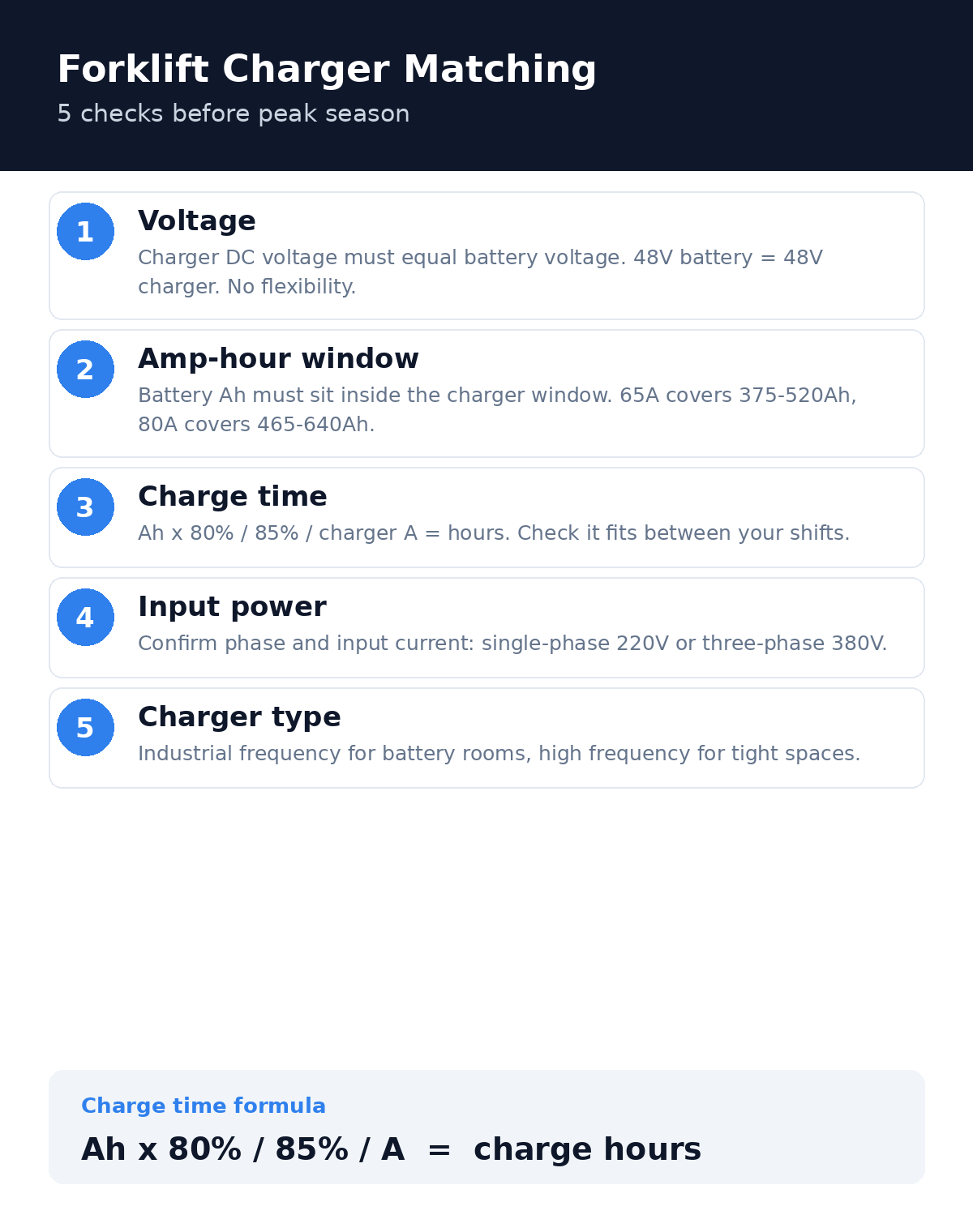
1Match the voltage — exactly
The charger DC voltage must equal the battery voltage. No flexibility here.
Most industrial batteries are built from 2V lead-acid cells, so the pack voltage comes in steps:
| Battery voltage | Cells inside (2V each) | Typical trucks |
|---|---|---|
| 24V | 12 | Pallet trucks, small stackers |
| 48V | 24 | Counterbalance forklifts, reach trucks |
| 72V | 36 | Larger electric forklifts |
| 80V | 40 | Heavy-duty forklifts |
If your battery label says 48V — like a 5PzS500 — the charger must be a 48V charger. A 24V or 80V unit will not charge it, no matter what the amp rating says.
2Match the amp-hour window — this is where most mismatches happen
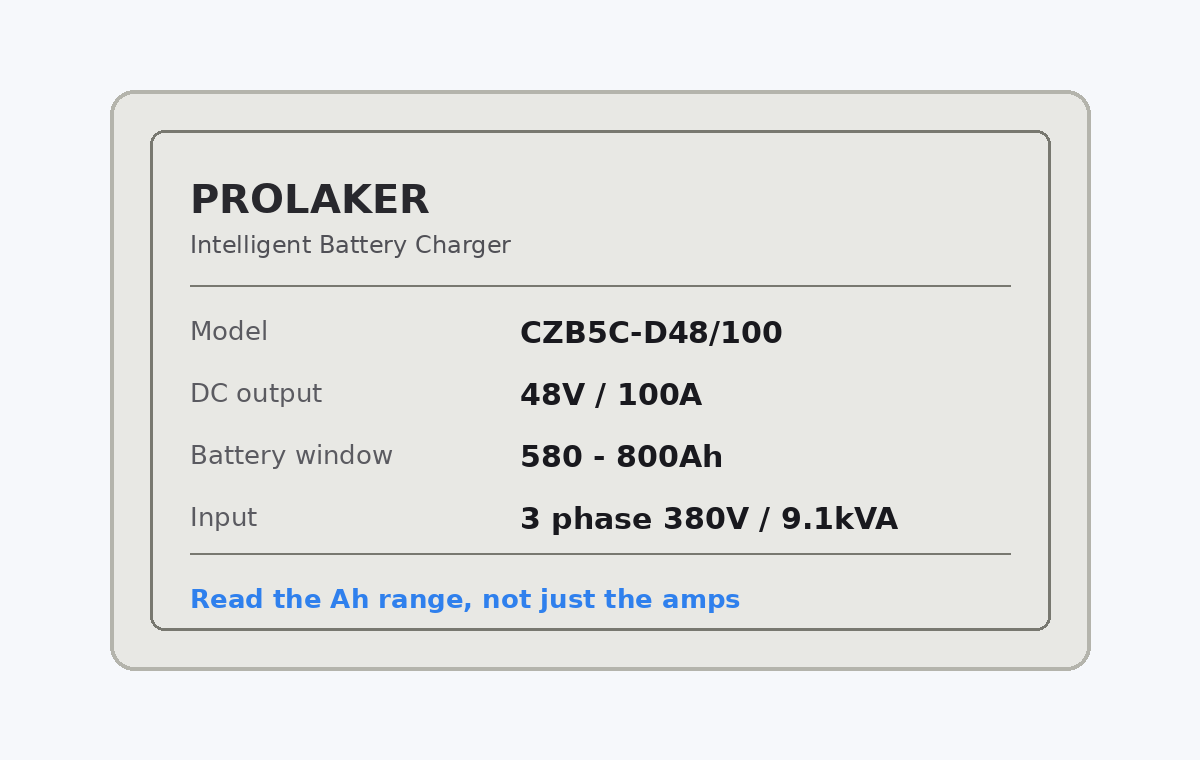
If you are asking what size forklift battery charger do I need, the answer sits in the amp-hour window — not in the amp rating alone. Chargers are rated for a range of battery sizes, not one size.
Here is a real example from our CZB5C series — the same 48V output line, three sizes (the 65A and 80A are each available in a single-phase E version or a three-phase D version; the 100A is a three-phase D model):
| Charger model | Output current | Battery window | Charge time (est.)* |
|---|---|---|---|
| CZB5C 48V/65A | 65A | 375–520Ah | ≈5.4–7.5h |
| CZB5C 48V/80A | 80A | 465–640Ah | ≈5.5–7.5h |
| CZB5C 48V/100A | 100A | 580–800Ah | ≈5.5–7.5h |
*Estimated from the window itself: window Ah × 80% ÷ 85% efficiency ÷ charger A — fastest time for the smallest battery in the window, slowest for the largest.
So a 500Ah battery sits inside both the 65A window (375–520Ah) and the 80A window (465–640Ah) — either works, and the 80A simply finishes faster (≈5.9h vs ≈7.2h from a 20% charge). A 700Ah battery, however, belongs to the 100A unit.
3Do the charge-time math for your shift
You do not need to guess — one formula, using numbers already on the battery label:
- × 80% — fleets rarely drain a battery to 0%; about 20% usually remains when the truck plugs in
- ÷ 85% — the charging-efficiency allowance
Two real examples with our 48V chargers:
- 500Ah battery on the 80A charger: 500 × 0.8 ÷ 0.85 ÷ 80 ≈ 5.9 hours
- The same battery on the 65A charger: ≈ 7.2 hours
If your fleet runs one shift, an overnight cycle is all you need. If you run two shifts with battery swap, the charging window between shifts becomes the real constraint — and that is when the bigger charger, or a spare battery rotation, starts to matter. Peak season is exactly when one-shift fleets start running like two-shift fleets. Do the math before 27 November, not after the first dead battery.
4Check what you can plug it into
Chargers need input power, and workshops differ. The same 48V/80A output in our CZB5C range comes in two input versions: the single-phase E version (CZB5C-E48/80) draws 27.3A from a 220V supply, while the three-phase D version (CZB5C-D48V/80) draws just 9.1A from 380V — the same charging performance, with a very different load on your distribution board.
Before ordering, confirm three things about your building:
- Phase: single-phase 220V or three-phase 380V? (Our E series runs single/two-phase; the D series runs three-phase.)
- Spare capacity: can your distribution board feed the charger input current on top of everything else?
- Location: near the truck parking spot, with ventilation for lead-acid charging
A charger that does not fit your power supply is a doorstop. Tell your supplier the site power first, not last.
5Choose the charger type: industrial frequency or high frequency
| Industrial frequency (transformer) | High-frequency | |
|---|---|---|
| Best for | Battery rooms, overnight cycles, two-shift swap charging | Opportunity charging, space-tight sites |
| Footprint | Larger, floor-standing cabinet | Compact — our ESCH48V/65A measures just 386×169×360mm |
| Character | Rugged, proven transformer technology, continuous-duty | Lighter, energy-efficient, quiet (silent-fan options for indoor points) |
| Typical use | 24V–80V traction packs, 375–800Ah | Pallet trucks, stackers, carts — our CZC7 smart series covers 24V–72V with automatic maintenance cycles |
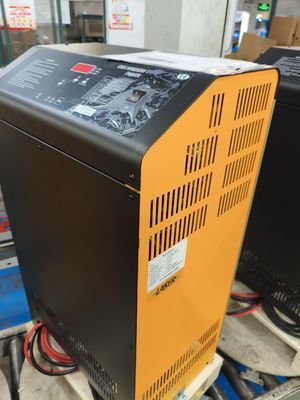
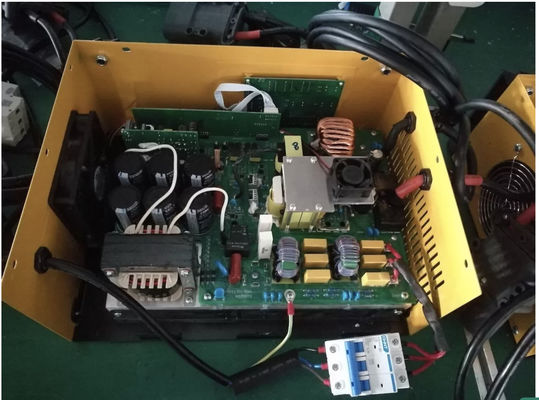
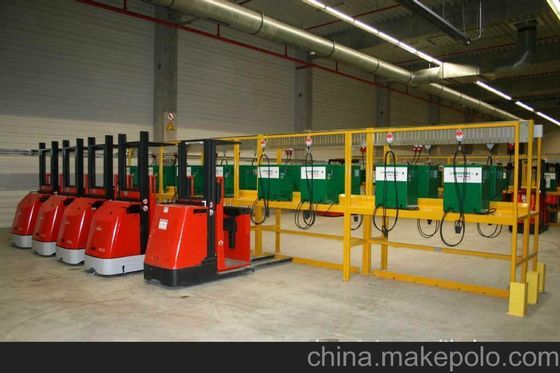
Neither type is better. A two-shift warehouse with a battery room usually runs SCR units happily for years; a cramped retail back room with one pallet truck is high-frequency territory. Our high-frequency range covers both ends of that scale: the compact ESCH series and the CZC7 smart series (24V–72V) with automatic equalizing and initial-charge cycles.
Two extras worth having: overcharge protection that tracks the charge curve and cuts off automatically (our 48V/120A unit uses double closed-loop PID control for exactly this), and multi-chemistry tolerance if your fleet mixes lead-acid and lithium.
The Pre-Peak 60-Second Checklist
Before the peak-season orders hit — or before you order any charger:
Related products: Forklift Battery Chargers · Forklift Traction Batteries · Battery Connectors

